
By Olivia Serougi
Public education workers are stretched, exhausted and too often isolated. In this article, I explain why I believe organising across every role and sector is how we change that.
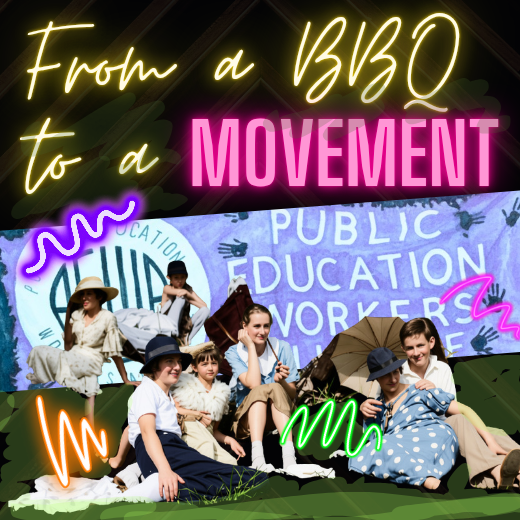
A barbecue in Blacktown is how it all began.
A little over 12 months ago, a friend invited me along to a PEWA social event. He explained that a group of education workers had formed an alliance to support one another and advocate for workers in the public education sector. Given my interest in union work, he thought I might like to be involved. Looking back, I’d like to believe it had more to do with the fact that he knows I’m a fighter, someone who believes in justice and a fair public education system for all.
The conversations at that first social event told me everything I needed to know, and the timing couldn’t have been better. I had recently been elected as the Federation Representative at my new secondary school in Sydney’s western suburbs, and I was feeling overwhelmed and powerless to change the working conditions I had come to accept as the norm. PEWA has taught me otherwise.
What PEWA is
PEWA members work across all public education institutions: primary and secondary schools, universities, TAFE, prisons and adult education services. We organise regardless of role or position: teachers, Student Learning Support Officers, cleaners, administrative staff, support workers, and everyone whose labour sustains public education every day. Our purpose is simple: to increase the collective power of public education workers.
We believe that public education workers, organised consciously and collectively, can do more than defend public education. They can help transform society. A public education system led by an organised and united workforce is a key pillar of a free, participatory society built on social power, security, democracy and community.
I agree, it’s an ambitious vision. But the times demand ambition.
An era of disorganisation
We are living through an era of systematic disorganisation, where the only thing that matters is profit, plunder and exploitation. Across the world, billionaire interests and ruling political classes are engaged in a coordinated offensive against working people. They attack wages and unions. They privatise public goods. They casualise work. They bombard people with the message that collective struggle is impossible. And they do it because they understand something working people must rediscover: organisation is power.
Marx observed that capitalism produces immense wealth while impoverishing human relationships. Lenin understood that the ruling class maintains power not only through force, but through ideology, institutions and the deliberate weakening of working-class organisation. Today, we see the results in fragmented workplaces, solidarity replaced by individual competition, and community replaced by consumerism.
Workers are told they are isolated individuals, rather than members of a class. Teachers are told to see themselves as professionals competing against one another. Families are treated as customers and schools as marketplaces, with education measured by productivity metrics and labour-market outcomes rather than human development.
Why public education is a target
A public school is not just a service. It is one of the few places where people from different backgrounds come together, where social bonds are formed, where democratic habits are practised and where the values of cooperation survive. That is why public education matters so deeply, and why it is targeted. When billionaires and governments attack it, they are not merely cutting costs. They are weakening one of the foundations on which collective power is built.
We see the results in our schools: chronic underfunding; impossible workloads; privatisation; precarious employment; universities run as corporate enterprises; and support staff overworked and underpaid. Then education workers are blamed for crises created by governments themselves.
The toll shows up in early-career attrition. Estimates of how many new teachers leave within five years range from 8% to 50%, and the Australian Institute for Teaching and School Leadership (AITSL 2016) concedes that without consistent national data, the true figure is unknown. What the research does point to, again and again, is heavy workload, job insecurity and a lack of support.
I feel this viscerally as a full-time high school teacher, a wife, a mother and a carer for my elderly parents. It is physical exhaustion, but it is also political exhaustion. Many workers feel isolated and powerless, and many feel that no institution truly represents them. That is not accidental. Disorganised workers are easier to exploit. But disorganisation is not permanent. Working people have rebuilt organisation before.
Every major gain won by workers (the eight-hour day, public education, public healthcare, workplace safety, collective bargaining rights) was achieved because ordinary people organised against enormous odds. Nothing was gifted to us. Everything was fought for. Our task today is not simply to defend what remains, but to rebuild workers’ organisation consciously, deliberately and politically.
Unity across every role and sector
For PEWA, that means rejecting narrow sectionalism. Fragmentation serves employers and governments. When teachers are separated from Student Learning Support Officers, when cleaners leave school before we arrive and arrive after we depart, when administrative staff are isolated in their office wing, when tertiary workers are disconnected from school workers, when prison educators are treated as separate from mainstream education, everyone becomes weaker. When workers recognise their shared interests, collective power grows.
Capital organises internationally and governments coordinate nationally. Workers must respond with deeper unity: across classifications, sectors, unions and communities. In NSW, health and education are home to some of the public service unions with the largest memberships – the NSW Teachers Federation and the NSW Nurses and Midwives’ Association. Therefore, it is important to think about how we connect these unions and their members.
Why this is political
Public education workers are part of the broader working class, and that means reconnecting unionism with politics. Not party politics in the narrow electoral sense, but politics in the deeper sense: who holds power in society.
Why are schools underfunded while military spending expands? Why are billions available for corporations while classrooms lack basic resources? Why are workers told there is no money for wages, but endless money for consultants and privatisation schemes? These are not technical questions. They are questions about class power, and unless we speak plainly about that, we will struggle to build the confidence and consciousness that collective struggle requires.
Building power, one conversation at a time
Workers do not spontaneously become organised. Organisation must be built, consciousness developed and leadership cultivated. That work cannot be outsourced. It happens through conversations with coworkers, collective campaigns, strikes, study groups and community organising. It happens when workers begin to see themselves not as isolated employees, but as historical actors capable of reshaping society.
Education workers have a unique role in this. Every day we help people develop knowledge, confidence, creativity and social connection. We know that people flourish collectively and that learning itself is social. That contradicts capitalism’s insistence that we compete endlessly against one another. So when we organise, we are defending more than our wages and conditions. We are defending the idea that society should be organised around human need rather than profit.
The crisis facing public education is inseparable from the broader crisis of capitalism. An economic system driven by profit maximisation cannot sustainably provide universal, democratic, human-centred education, because genuine public education develops the critical thinking, solidarity and democratic participation that can challenge ruling-class power. So every struggle for public education raises larger questions. Do we want a society organised around competition or cooperation? Do we want social wealth controlled privately or democratically? Do we want education to serve profit, or human liberation? These are political questions, and workers must answer them politically.
There are no shortcuts, but there are foundations to build on. We can rebuild workplace organisation, develop rank-and-file leadership, deepen political education, strengthen democratic participation, build solidarity across industries and reconnect unions to broader social movements.
Most importantly, we can restore confidence in collective action itself. One of neoliberalism’s greatest victories has been convincing workers that nothing can change. Our task is to prove otherwise. Every organising conversation matters. Every union delegate matters. Every workplace meeting matters. When I mentor early career teachers, my most common advice is to form connections: if students feel a connection, learning happens organically. The same is true of organising in our workplaces. Form connections, and solidarity will follow without coercion.
History is made by ordinary people
I’m sorry, Trump, but history is not made by billionaires. It is made by ordinary people acting collectively. The working class built every school, every railway, every hospital, every university, every public institution that society depends upon. If working people created this society, then working people can transform it. That belief is at the heart of my work with PEWA, and it is the belief that must guide us now.
As education workers, unionists and organisers, we must commit not only to resistance, but to reconstruction: rebuilding collective strength where individualism has been imposed, democratic organisation where passivity has been encouraged, and class consciousness where fragmentation has been cultivated.
Why I show up
I battle feelings of frustration and hopelessness every single day. But I show up because I see that the work of the comrades I’ve met through PEWA changes lives. When a comrade stands up at Federation Council and speaks passionately about increasingly difficult working conditions to inform decisions. When my Federation organiser supports teachers at the brink of physical and emotional breakdown and wins against Department bureaucrats. When a retired teacher member informs my activism with a new piece of political history. In those moments I feel inspired, and I know I want to fight for a public education system, and ultimately a society, organised around human dignity, collective power and social liberation, not exploitation and profit.
So I wake up every day, with a tired body that isn’t getting any younger, and repeat Wael Ghonim’s words as my mantra: “The power of the people will always be greater than the people in power.”
Join us
PEWA is for every public education worker, whatever your role or workplace. If you’re tired, isolated or simply curious, come along to our next meeting or social event, meet people who understand, and see what organising together feels like. Visit our events page to find upcoming events and learn how to join. Bring a colleague, because every organising conversation matters, and yours could be the next one.
PEWA encourages members and supports to download and print out this article to handout to other public education workers (and workers in general) who are interested in organising within their workplace and what we can do to build power for teachers in schools.