
By David Clarke, NSWTF member, Fed Rep & HSR who still turns up on Monday
Are you allowed to love teaching and still be furious about the conditions it happens in? Of course you are. In fact, if you walk into a classroom in 2026 and feel nothing but contentment, you probably haven’t been paying attention.
There is nothing naive about the joy of a Year 9 kid finally getting it. There is nothing soft about the quiet pride of watching a student who arrived with no English read a paragraph aloud. These moments are real, and they are why most of us stay. But we should be suspicious of anyone who tells us that passion is a renewable resource we can draw on forever, free of charge, while the system around us burns through it.
That is the point. Teachers are routinely told that resilience is a personal virtue. Do some yoga. Download the wellbeing app. Remember your “why”. The employer, of course, is delighted when we cope. A coping workforce is a cheap workforce. Every hour of unpaid planning, every combined class, every vacancy filled by a colleague’s goodwill is a subsidy from our own nervous systems to a government that would rather not fund the real thing.
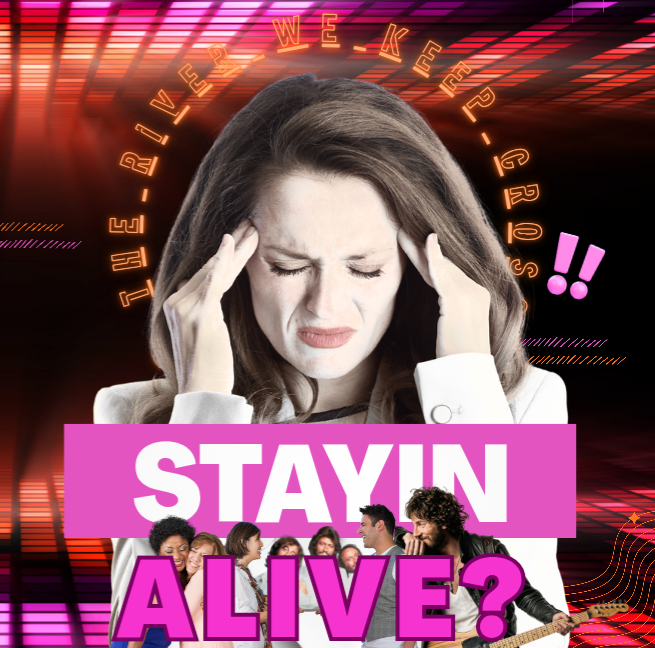
So how do we stay in tune? Two songs, written by blokes who never marked a roll, explain it better than any professional learning module.
Staying Alive
The Bee Gees released it in 1977, and it gets played at weddings and gyms as a bouncy anthem of confidence. Listen to the words. “Life goin’ nowhere, somebody help me.” “Feel the city breakin’ and everybody shakin’.” It is a song about a worker getting through a brutal environment on rhythm alone. The strut is not denial. The strut is armour.
That is what teachers do. We develop the strut. The gallows humour in the staffroom. The group chat that exists purely so someone can type “I’m not okay” and get seven replies in four minutes. The colleague who slides a coffee across your desk without a word on the day she can see you are drowning. None of that is in the school plan, and all of it is keeping the place running.
And here is the thing worth noticing: the strut is collective. The song is a beat, and a beat is a shared thing. You cannot stay alive alone in a faculty room. The teachers who last are the ones who find their people, who share resources instead of hoarding them, who say “I’ll cover your duty” without being asked. That is survival, but it is also something more. It is the seed of solidarity, practised daily, in miniature, on the smell of burnt microwave popcorn.
But survival is the floor, not the ceiling. A profession that celebrates its own endurance without asking why endurance is required has quietly accepted the terms.
The River
Springsteen’s song is the other half of the story. It is slower and sadder, and it understands something the Bee Gees only imply. “Is a dream a lie if it don’t come true, or is it something worse?” That line should be printed on the back of every graduate teacher’s lanyard.
Because the dream is real. Most of us came in believing that education could widen a kid’s world. And then the river runs dry: the workload, workplace violence, the casualised colleagues who never know if they have a job next term, the relentless paperwork that has nothing to do with learning. The song knows what it is to hold onto a promise while the conditions that made it possible slowly erode.
What does the narrator do? He keeps going back to the river. Not because it is easy, but because it is theirs. The memory of what it meant is the thing that carries him. For teachers, that memory is the kid who wrote you a note, the class that finally laughed at the right moment, the Year 12 who got into the course that was never supposed to be on the table. We hold onto those moments the way others hold onto a photograph.
But a river is also a place where people gather. And the most important thing teachers do to stay in tune with the passion is the thing no one puts in the wellbeing newsletter: we organise. We go to the meeting. We vote on the action. We stand in the rain outside Parliament in a sea of red shirts and realise that the thing we have been carrying alone is shared by thousands of people who also marked until midnight last night.
That is what turns private despair into public strength. It is hard to feel like the problem is you when you are standing next to forty thousand colleagues who all know it is the system.
What the two songs have in common
On the surface, they could not be more different. One is a disco heartbeat, the other a harmonica-soaked lament. But they are circling the same truth. Neither song pretends that the individual can solve a structural problem by trying harder. Both are about people trapped in conditions they did not choose, finding ways to keep their dignity intact.
The Bee Gees give us the rhythm to get through the week. Springsteen gives us the memory of why it matters. What neither can give us, and what we have to build ourselves, is the power to change the conditions.
That is the part the department would prefer we forget. Passion is not the problem. Passion is the engine of the whole profession. The problem is that our passion has been quietly converted into an unpaid asset, and the only reliable way to take it back is to act together.
So yes, keep the strut. Keep the group chat and the gallows humour and the shared coffee. Keep going back to the river, to the memory of the work at its best. These are not signs of weakness. They are how people sustain a meaningful life inside a system that would rather they didn’t.
But do not stop there. Refuse the sentimental lie that surviving is the same as winning. Refuse the idea that burnout is a personal failing rather than a predictable outcome of underfunding. The real lesson of both songs is bigger than any one classroom. It is that ordinary working people, side by side, can hold each other up long enough to start demanding better.
Not because the department tells us to. Not because a wellbeing consultant has discovered “resilience”. But because a union is what happens when people who love their work decide it deserves to be properly valued. And that, not another mindfulness webinar, is the tune teachers should be dancing to.